THE STORY OF CHAMPAGNE YVELINE PRAT
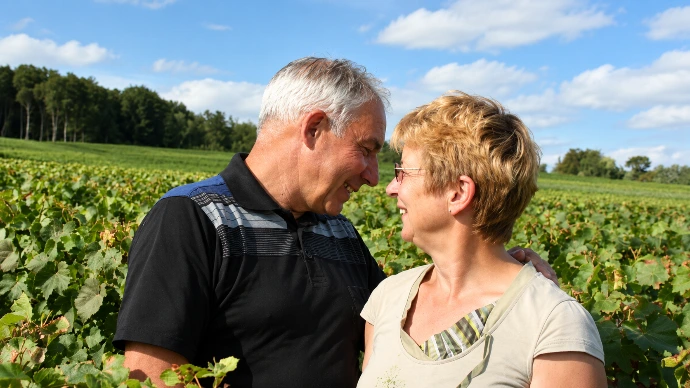
The story of Champagne Yveline Prat began in 1975, when we met at dances in our local villages while dancing rock ’n’ roll – and from that moment on, we never left each other’s side.
United by a shared passion for working the vines and making wine, we founded our own estate that same year.
As Champagne producers, Récoltant-Manipulant and independent winegrowers, we cultivate and care for our vineyards throughout the year.
Together, we create our blends in our own cellars to produce high-quality grower Champagne.
Our Champagne is also bottled directly at the estate.
OUR VINEYARDS
We gradually expanded our vineyards, always seeking the finest terroirs for each Champagne grape variety.
Today, we cultivate vines on a number of different slopes:
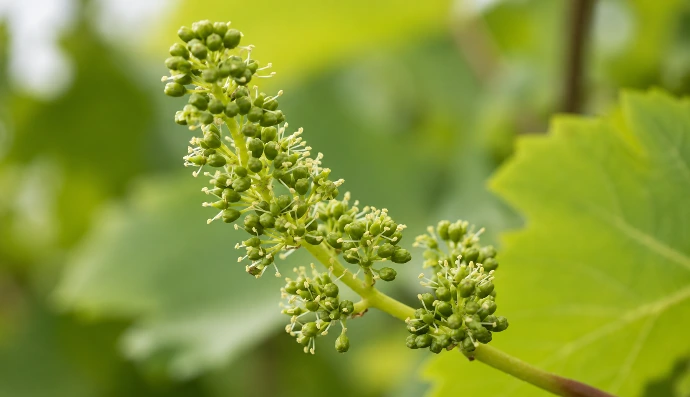
On the Côte des Bar, we mainly grow Pinot Noir, while our Pinot Meunier thrives in the Marne Valley.
Our Chardonnay grapes are harvested from our vineyards in the Coteaux Sézannais, particularly around the small village of Vert-Toulon, where our cellars are located.
This diversity provides us with a rich palette of flavours and allows us to maintain a consistently high level of quality in our Champagnes.
WORKING THE VINES
Working in the vineyard is at the very heart of our profession as winegrowers. Great Champagne begins with beautiful, high-quality grapes.
Together with our team, we devote several hundred hours of work per hectare every year to achieving a high-quality harvest. Most of this work is still carried out by hand, helping us protect both the vines and the grapes.
Throughout the year, our team carefully tends the vineyards. With proper care, a vine can live for more than 80 years.
Every vineyard is different. The grape variety, its exposure to the sun, its location in relation to the village and, above all, its terroir all influence the way the vines grow. These factors also shape the aromatic profile of the grapes and ultimately the Champagne itself.
Planting a vineyard is therefore an important step for a winegrower. Selecting the grape variety best suited to each terroir is essential to producing beautiful, high-quality grapes for decades to come.
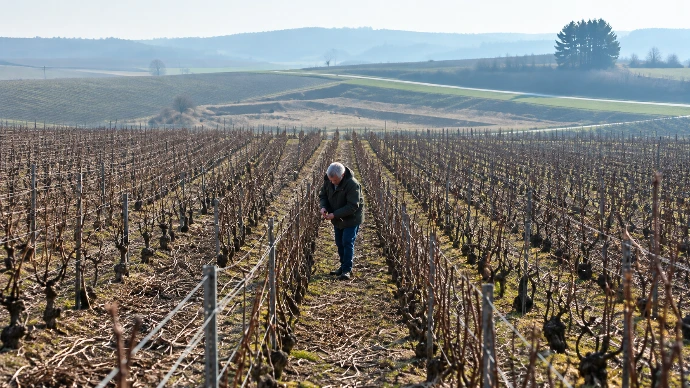
Vineyard work follows a twelve-month cycle, beginning with one of its most important stages: pruning. From November to March, we select the best canes to carry the grapes for the following harvest.
Left to itself, a vine would grow like a wild
climbing plant. The work that follows allows us to guide its growth, ensure
optimum exposure to sunlight and focus its energy on producing high-quality
grapes.
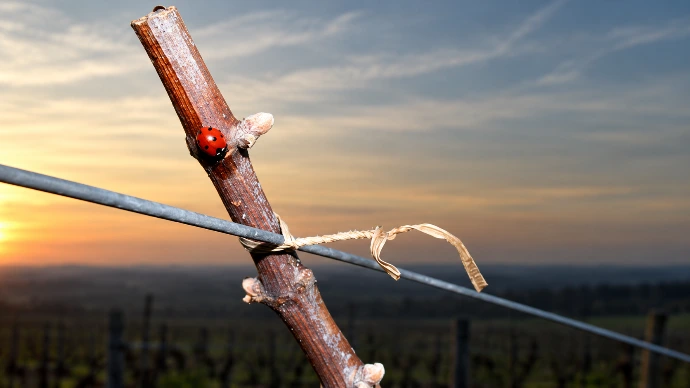
From March to August, we tie the shoots, remove
unnecessary buds, lift and trellis the vines and trim their growth – all with
one objective in mind: the harvest!
HVE CERTIFICATION
Since December 2019, our estate has held HVE – Haute Valeur Environnementale certification.
Every year, we continue to improve our vineyard practices in order to respect nature as much as possible while protecting our vines and our work:
- We shred the wood removed during pruning rather than burning it, reducing carbon emissions while returning organic matter to the soil.
- On more than half of our vineyards, we use mating disruption techniques to reduce the need for insecticides.
- We now mainly use biocontrol products to protect our vines from disease in a more natural way, intervening only when necessary.
- We have reintroduced partial ground cover in our vineyards to reduce erosion and encourage the natural aeration of the soil.
- We preserve and maintain hedgerows around our vineyards to encourage greater diversity among insects and other wildlife.
HVE certification recognises the efforts we have made over recent years. We nevertheless continue to improve our vineyard practices in order to further reduce our impact on the environment.