THE STORY OF THE HOUSE
A family of builders
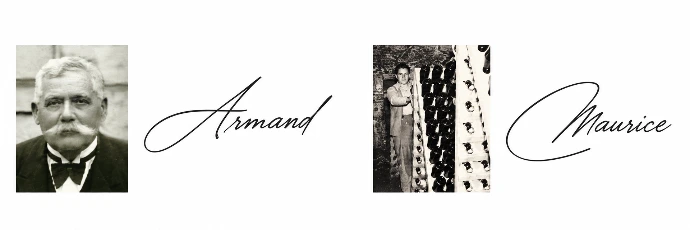
It all began with Amand Grumier, the great-grandfather, who became the first member of the family to produce his own Champagne in 1928, although the Grumier family had been winegrowers since the 18th century. His wife, Aline, worked alongside him on the estate until the Second World War.
After the war, Maurice took over the two-hectare estate in 1945, which then became Champagne Maurice Grumier.
At that time, only one cuvée was produced, available as Brut, Demi-Sec and Sec. The vineyards were planted almost exclusively with Meunier, alongside a small amount of Pinot Noir.
A period of rapid development
Barely in his twenties, Guy took over the estate following the death of his father Maurice. He planted the estate’s first white grape varieties, invested in cutting-edge equipment for the time, modernised the winery and expanded the vineyards from two to six hectares, planting much of the new vineyard himself.
During the 1980s, Guy and his wife Françoise innovated by creating new cuvées, while increasing numbers of customers discovered the estate.
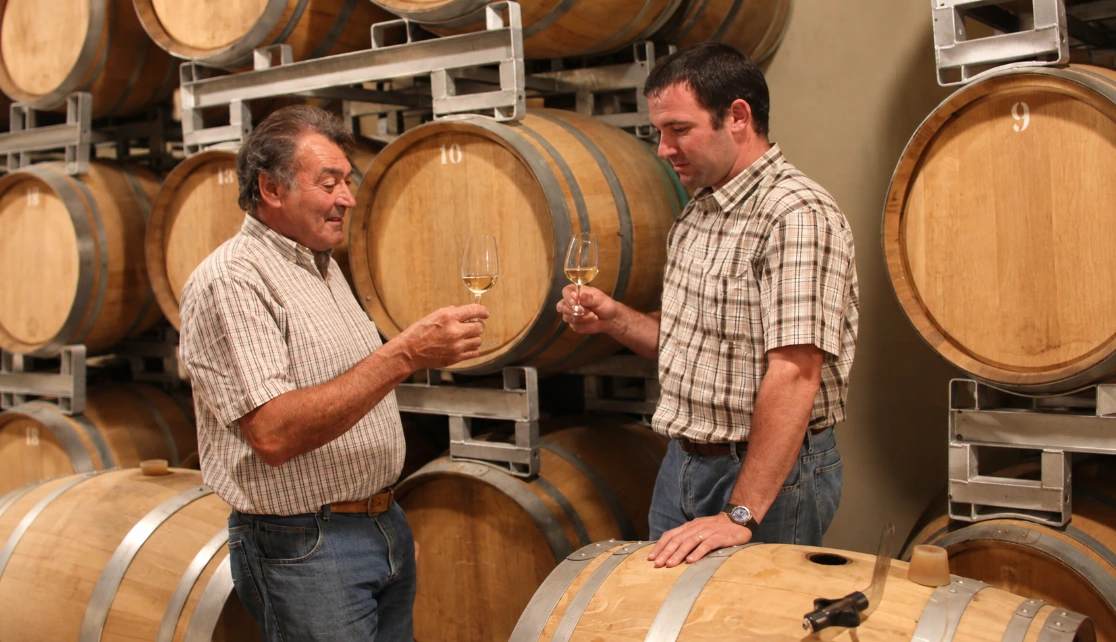
Fabien naturally followed the path established by his father. Driven by the same passion as the generations before him and guided by strong environmental and sustainable convictions, he continued the development of the House.
The Grumiers are a family of winegrowers whose love of the land and the vine has been passed down from one generation to the next. Today, this heritage is proudly embodied by Fabien, the twelfth generation of this long family line.
NEW SENSATIONS
Fabien represents the fourth generation of Récoltant-Manipulant and has managed the estate since 2006, supported by his wife, Hélène..
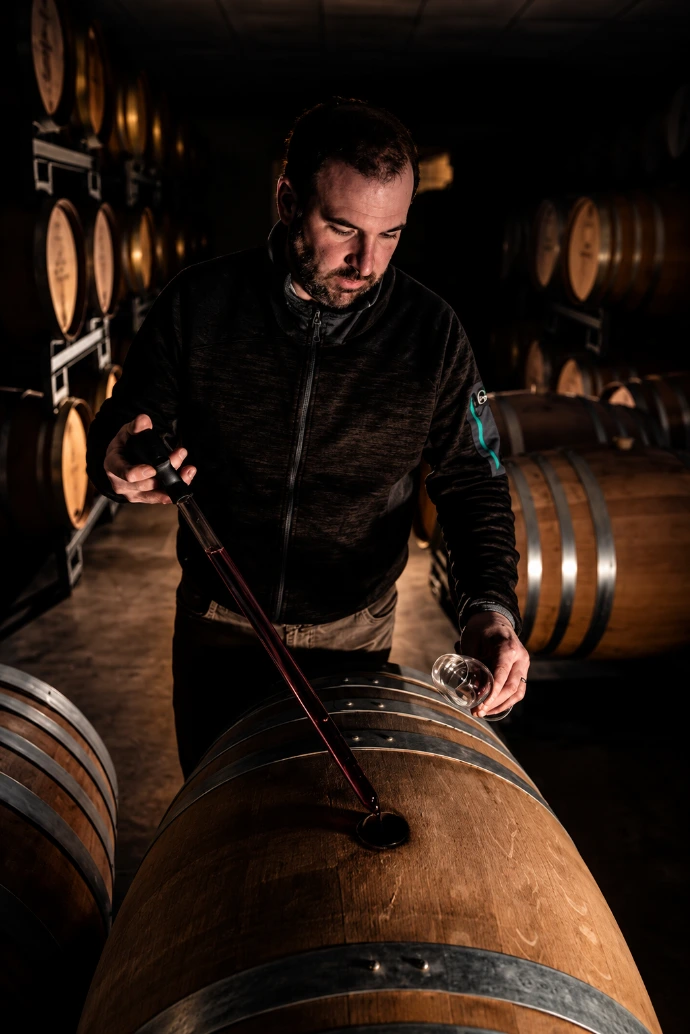
For several years, he has explored the possibilities offered by barrel ageing. Constantly experimenting and discovering new approaches, he sees wood as a living material: the wine lives inside the barrel, breathes and expresses itself.
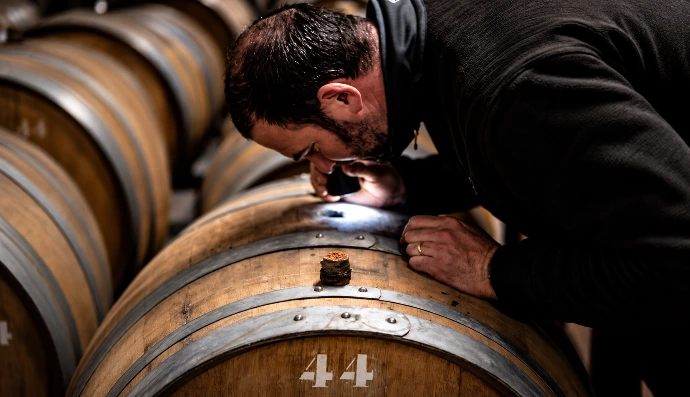
Every material creates a different sensation. Fabien smells, listens, observes, touches and tastes what wood and stainless steel bring to the wines. Wood contributes richness and complexity, while stainless steel brings freshness and tension.
The soil also determines an aromatic profile, while each grape variety reveals its individual characteristics as it is transformed into wine.
Through this continuous work, Fabien seeks to translate these sensations into refined, rich and expressive Champagnes.
PHILOSOPHY
Canaliser une force vive
The Grumier family has always been driven by energy, curiosity and a desire to discover..
Fabien inherited this character. Deeply passionate about vines and the land, he is constantly exploring new experiences. Diving, photography, fine gastronomy and travelling with his wife are among his passions, as is discovering other cultures.
Sharing his passion and profession with others is central to who he is. He follows the work of fellow winegrowers in France and around the world and enjoys sharing his discoveries.
This same energy is reflected in the family’s work and their constant dedication to their vineyards and wines.
VITICULTURE
A land of character
Fascinated by his terroir and the sensations it can create, Fabien pays meticulous attention to every vineyard plot. He continually deepens his understanding of the land in order to reveal its finest expression through his wines.
On the right bank of the Marne, approximately 4.5 hectares are located in Venteuil, Damery and Reuil, predominantly on chalky soils with a significant presence of clay and some sand on the upper slopes.
On the left bank, a little over 4.5 hectares are divided between Festigny, with predominantly limestone soils, and Dormans, where clay is more prevalent.
Festigny is particularly suited to Meunier, the signature grape variety of the Marne Valley. Meunier represents 55% of the estate’s plantings. Chardonnay accounts for 20%, while Pinot Noir represents the remaining 25%. Together, these vineyards provide Fabien with an exceptional range of possibilities for blending: 9 hectares across 7 different crus, situated on both sides of the Marne.
Live and let live
Fabien follows a sustainable and environmentally respectful approach to viticulture and was among the first Champagne winegrowers to receive HVE – Haute Valeur Environnementale certification in 2014.
He favours natural ground cover between the rows and works the soil through ploughing.
For Fabien, as the climate and soil evolve, the
wines evolve too. Natural and environmentally respectful practices are
therefore essential to limiting the impact of his work.
He would rather leave his mark on his wines
than on the environment.
A FEW FIGURES
In the vineyard

Vineyard
area: 9 hectares
Grape
varieties: 55% Pinot Meunier, 25% Pinot Noir, 20% Chardonnay
Vineyard
plots: 31Crus:
7
Average
vine age: 30 years
Oldest
vines: planted in 1968)
Nombre de parcelles : 31
Nombre de cru : 7 (Venteuil, Damery, Reuil, Dormans, Festigny, Nesle le Repons, Baslieux sous Chatillon)
Âge moyen des vignes : 30 ans (La plus vieille vigne fût plantée en 1968)
In the cellar

Bottle
stock: approximately 4 years
Reserve
still wines: 400 hl
Annual
production: approximately 80,000 bottles
Stock en vin clair (Réserve individuelle) : 400 HI (3/4 d’une année de production)
Production annuelle : Environ 80 000 bouteilles
WORKING THE VINES
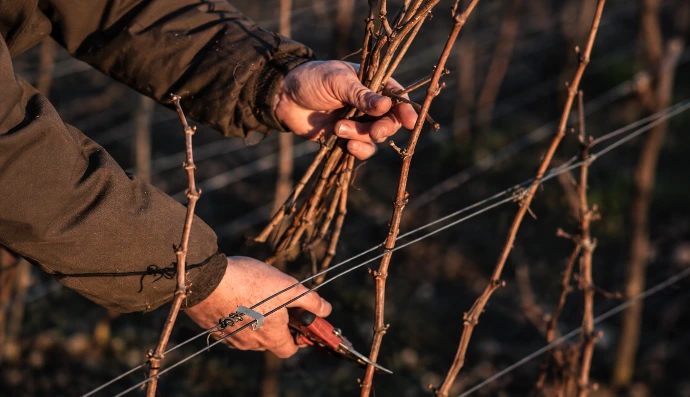
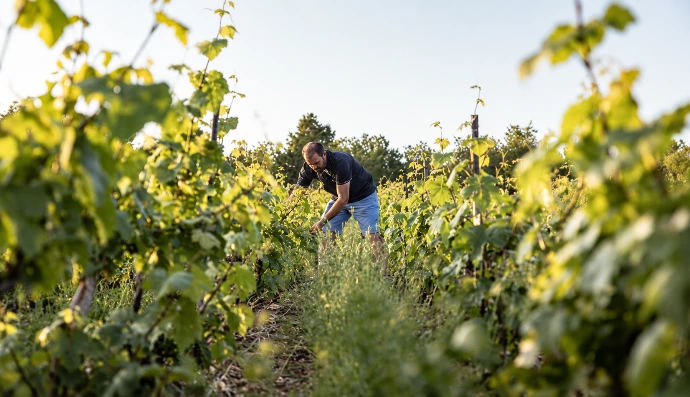
Every intervention is carefully considered. The soils are ploughed and natural vegetation is managed to regulate vine vigour and reduce the risk of disease.
Careful management of this vegetation allows the estate to avoid insecticides and anti-rot treatments while significantly reducing the use of herbicides.
No treatment is systematic. Interventions
during the growing season are determined according to actual disease pressure,
with doses adapted to the vines using modern agricultural technology.
The estate also treats its waste and does not
discharge untreated effluent.
The deeper the roots reach, the more strongly
the terroir can express itself through the wine.
This mosaic of expressions gives each cuvée its
own personality and identity.
« Il ne suffit pas de posséder un grand terroir, il faut le respecter et permettre à la vigne d’en exprimer le caractère. »
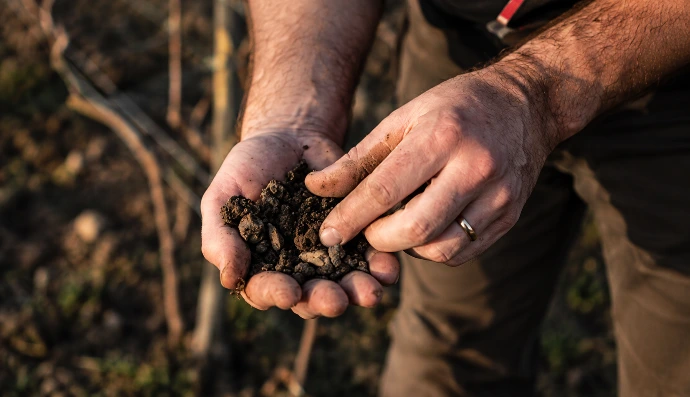
L’aération des sols par le labour et l’enherbement favorise l’enracinement de la vigne et la vie microbienne.
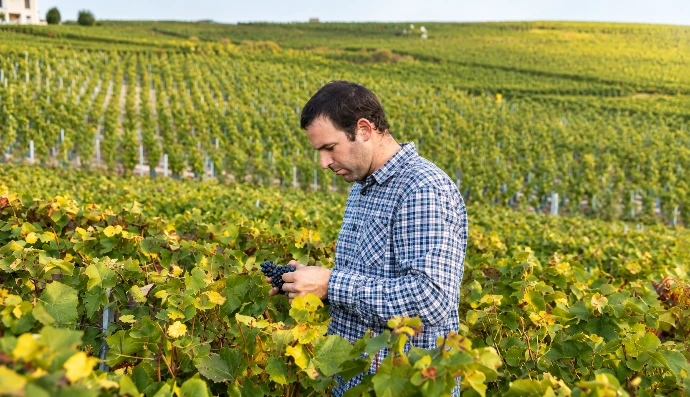
Lorsque l’enracinement est profond, l’empreinte du terroir est plus fort que celui du cépage. Plus la racine est en profondeur, plus elle extrait les éléments nutritifs du terroir, garanties de la qualité des raisins.
Cette mosaïque d’expressions, engendre pour l’assemblage de chacune de nos cuvées, une personnalité et une identité propre.
WINEMAKING
Always moving forward
Like the generations before him, Fabien continuously invests in modernising the estate. Cutting-edge technology is combined with traditional techniques and knowledge.
The three-level press has been designed so that the juice flows by gravity directly into the tanks for settling. Pressing is gentle, with each vineyard plot pressed separately.
The estate’s modern, temperature-controlled stainless-steel winery allows extremely precise vinification in very small volumes – grape variety by grape variety and plot by plot.
Reserve wines are also stored at controlled temperatures to preserve their freshness and finesse over the years.
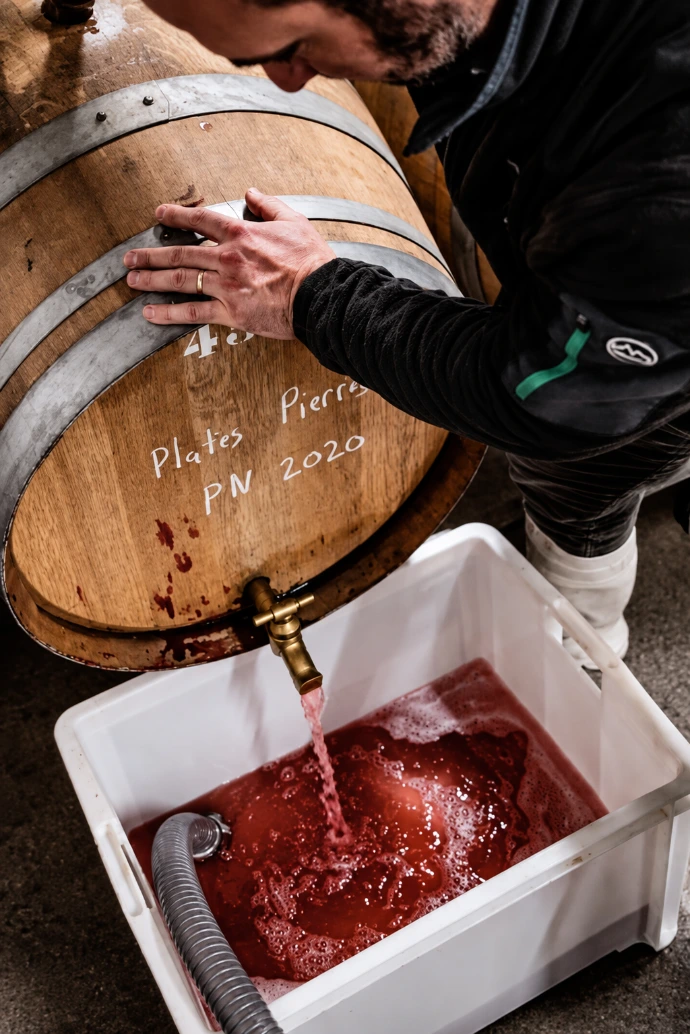
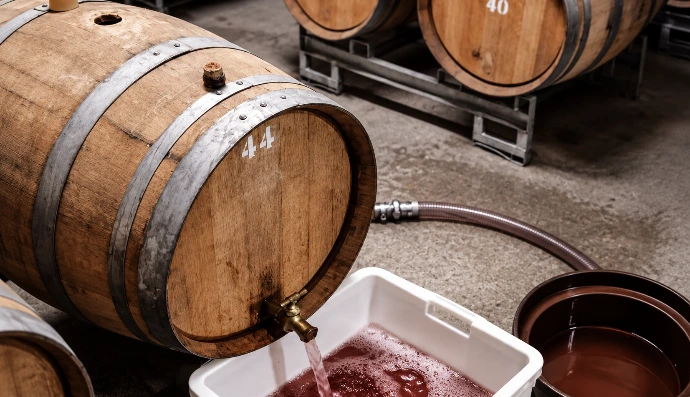
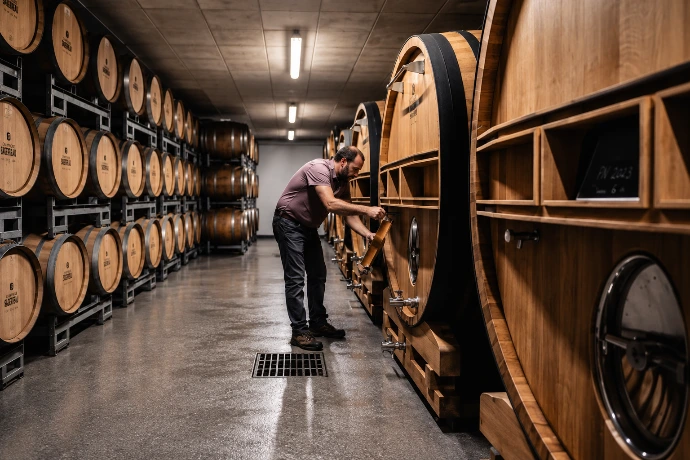
Around one hundred barrels and larger wooden casks further expand the possibilities. Approximately 50% of the total juice begins alcoholic fermentation in wood and remains in barrel for between 6 and 18 months, depending on its quality and intended use.
The purpose of the wood is to bring richness to the Champagnes while preserving freshness rather than introducing dominant woody aromas.
Combining stainless-steel tanks and barrels allows the estate to create more than one hundred different base wines each year, providing remarkable freedom when composing the final blends.
Fabien creates rich and complex wines centred around freshness and aromatic expression. His approach is deliberately low-intervention, allowing the wines to express themselves and reveal the character of their terroir.
The wines are not fined and the vast majority are not filtered.
The aim is to create a natural harmony between
the fruit and the mineral character of the soil. Reserve wines and wines from
the current vintage, barrels and tanks, with or without malolactic
fermentation, different grape varieties, vineyard exposures and old vines all
provide the palette from which the individual cuvées are created.
At disgorgement, the Champagnes receive little
or no dosage, allowing them to express themselves as fully as possible.
Pressing of the highest quality.
A visual and sensory selection of the juices.
Minimal settling. Slow vinification, carefully adapted to the potential of each terroir. Ageing takes place in tanks, oak barrels of different sizes and origins, egg-shaped concrete vessels or stoneware amphorae. No unnecessary intervention.
No fining and no filtration. Wine transfers are kept to a minimum, with gravity favoured whenever possible. We allow the wine to develop at its own pace and naturally find its balance.
Our approach to winemaking is a natural continuation of the work carried out beforehand in the vineyard. We aim to preserve all the richness of the grapes: their fruit, balance and individual character. We intervene as little as possible, allowing the grapes to express their full potential.
No two years are alike, so we adapt to the conditions of each vintage. The order of harvesting is naturally determined by the ripeness of the grapes in each village and each individual plot.
Our desire to create champagnes with character leads us to vinify each village, each grape variety and each plot – whenever its size allows – separately.
For us, vinifying a multitude of terroirs separately is essential to ensure the consistency, finesse and precision of our blends.
PASSION AND PATIENCE
Since 2005, Fabien has used a Solera system,
allowing young wines to mature in contact with older wines.
Each year, part of the wine is removed from the
barrels and bottled. A proportion remains and is replenished with young wines
from the latest vintage.
Over time, the wines gain maturity while
maintaining freshness through the regular addition of younger wines.
Combined with another perpetual reserve
system, the Solera enables Fabien to create Champagnes with character
according to a simple principle:
“The old wine educates the young.”
Couplée à un autre système de réserve perpétuelle, cette Solera permet à Fabien de pouvoir composer des Champagnes de caractère par un principe selon lequel le « vieux vin éduque le jeune ».
IN THE SILENCE OF OUR CELLARS
The family has always favoured long ageing:
a minimum of 4 years for non-vintage Brut
Champagnes and 7 years for vintage Champagnes.
Great wine requires great patience.
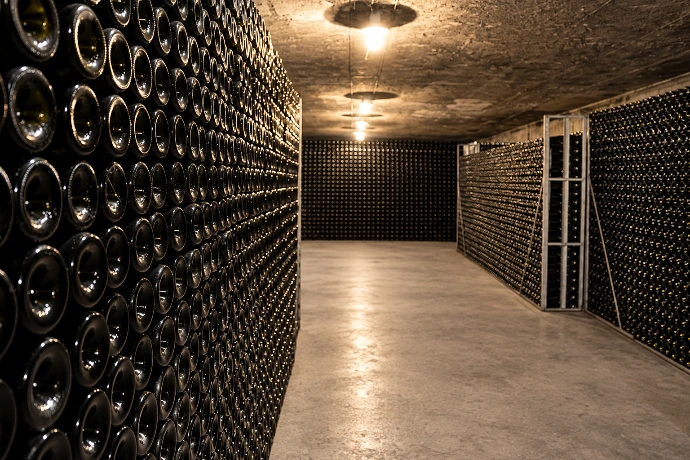
Around 250,000 bottles rest quietly in
the cellars awaiting disgorgement. Some bottles are still riddled by hand,
often by Guy, who continues to lend a hand with certain tasks.
Long ageing brings additional complexity and
richness to Grumier Champagnes.
Just like the family itself, their full
strength of character reveals itself over time.
Au total, le stock représente 250.000 bouteilles qui attendent calmement d’être dégorgées. Certaines bouteilles sont encore remuées à la main, souvent par Guy qui tient à continuer à prêter main forte pour certaines tâches.
Les longs vieillissements offrent de la complexité aux Champagnes Grumier. Ils procurent une grande richesse aux cuvées de Fabien. À l’image de la famille, c’est dans le temps que s’exprime pleinement leur force de caractère.
Notre souhait est de créer un lien naturel qui traduit une belle harmonie entre la matière du fruit et les sels de la terre. De nos vins de réserve aux vins de l’année, en fûts ou en cuves, avec malolactique ou sans, Pinot Noir ou Chardonnay, parcelles du bas ou parcelles de coteaux exposées au sud ou à l’est, vieilles vignes ; tel est l’ensemble de nos étoffes pour la composition de nos 9 pièces uniques… Et pour laisser la place à la pleine expression de nos champagnes, au dégorgement, nous avons fait le choix de ne pas ou peu doser.