A Page of History
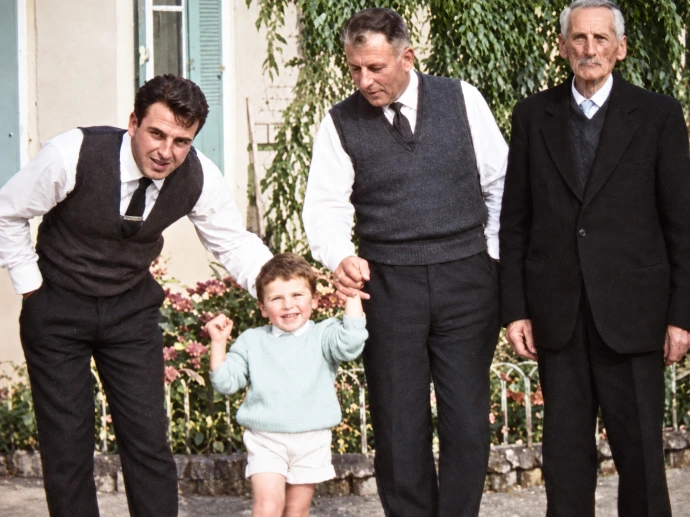
Since Nicaise LACOURTE (1630), our family has been growing vines in Écueil for 12 generations.
At that time, we produced still red and white wines, intended first for the clergy and later for wine merchants.
It was in 1947, after the war, that Henri LACOURTE began producing Champagne under the LACOURTE LABASSE brand.
In 1959, his son Yves LACOURTE married Jeanine GUILLEMART from the neighbouring village, and together they created the LACOURTE GUILLEMART brand.
In 1959, his son Yves LACOURTE married Jeanine GUILLEMART from the neighbouring village, and together they created the LACOURTE GUILLEMART brand.
From Horse to Vineyard Tractor
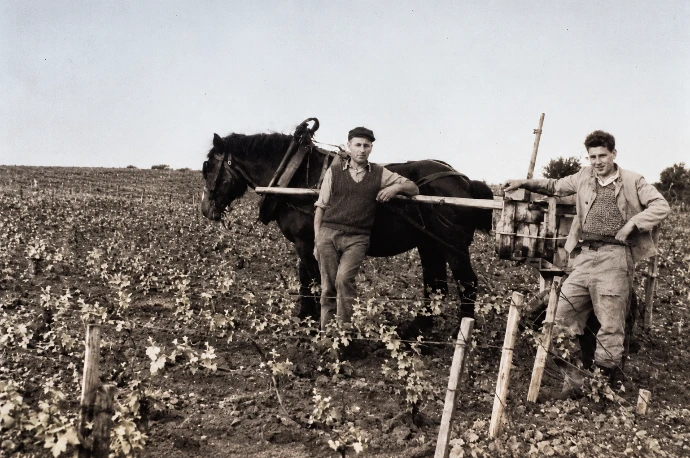
How many generations worked with oxen and horses? How many winegrowers relied on them? How much invaluable work did they accomplish?
Countless.
As soon as tractors became available, they contributed greatly to agricultural development, making vineyard work easier and faster. Through a series of photographs, we look back at the different stages in the evolution of traction equipment used at Champagne LACOURTE GUILLEMART.
Work in the Cellar
Riddling
Riddling is an essential stage in the production of Champagne.
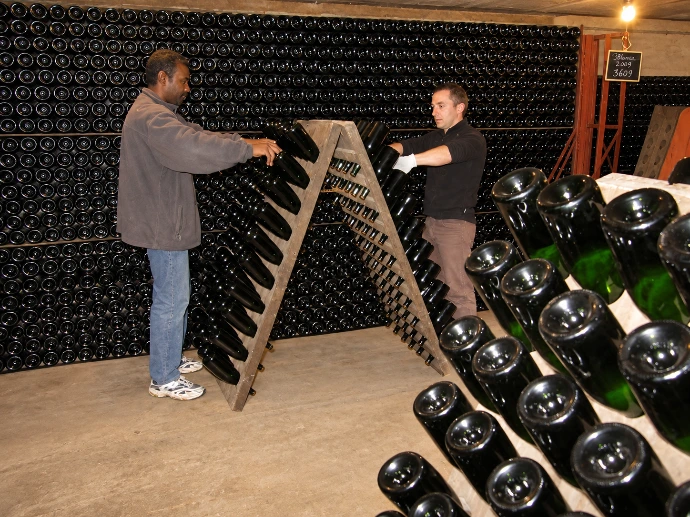
It is carried out by hand on traditional riddling racks for vintage Champagnes, Prestige, half-bottles and magnums, or mechanically using gyropalettes for the other cuvées.
After the harvest, we first produce a still wine. We then create our blends to obtain specific cuvées such as Blanc de Blancs, Rosé, Prestige and vintage Champagnes. The wine is bottled with yeast for a second fermentation, during which carbon dioxide is produced.
After a few weeks, the yeast has consumed the sugars and dies, forming a sediment. After several years in the cellar, the bottles are placed on riddling racks. Every day, each bottle is gradually tilted and turned so that the sediment slowly moves towards the neck. Then comes the next stage...
Disgorgement
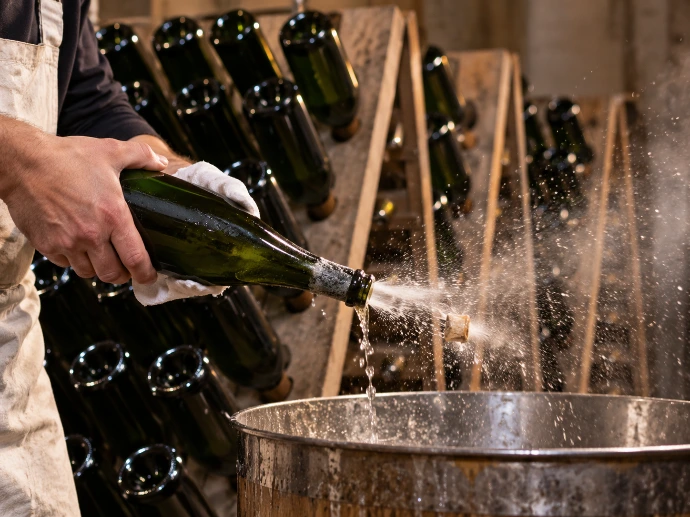
Disgorgement removes the plug of sediment collected in the neck of the bottle.
In the past, disgorgement was performed by slowly bringing the bottle upright. Thanks to the pressure inside the bottle, the cap and sediment were expelled when the bottle was opened, at the precise moment when the air bubble reached the neck. Today, this method is used only for large-format bottles.
Nowadays, the neck of the bottle is immersed in a liquid at -30°C, freezing the sediment. The cap and frozen sediment are then expelled by the pressure of the gas when the bottle is opened.
The resulting Champagne is perfectly clear and brilliant.
The liquid lost during the expulsion of the sediment is partially replaced with an expedition liqueur, also known as dosage liqueur, made from a mixture of cane sugar and wine. The quantity added determines the style of Champagne: BRUT 5 to 15 g per litre – DEMI-SEC 33 to 50 g per litre.
Maison LACOURTE GUILLEMART uses high-quality corks, providing the best possible protection for the aromas and flavours that have been so patiently developed.
Dressing the Bottles
This is the final finishing stage before the bottles are ready for sale.
Before reaching the dressing line, the washed and dried bottles successively receive:
- a foil capsule covering the cork and part of the neckl
- a neck label
- a front label and, where applicable, a back label
- and sometimes a medallion
Some bottles are still dressed entirely by hand.
This is the case for the Prestige bottle, half-bottles, magnums and jeroboams.
Once dressed, certain bottles are wrapped in tissue paper or cellophane before being packed alternately head-to-tail in cases or cartons of six bottles for individual sales.
For larger quantities, they are stacked on pallets and secured with plastic film.
Depending on the occasion or commercial offer, bottles may also be presented in individual cases or gift boxes. Some are shipped in traditional wooden cases.