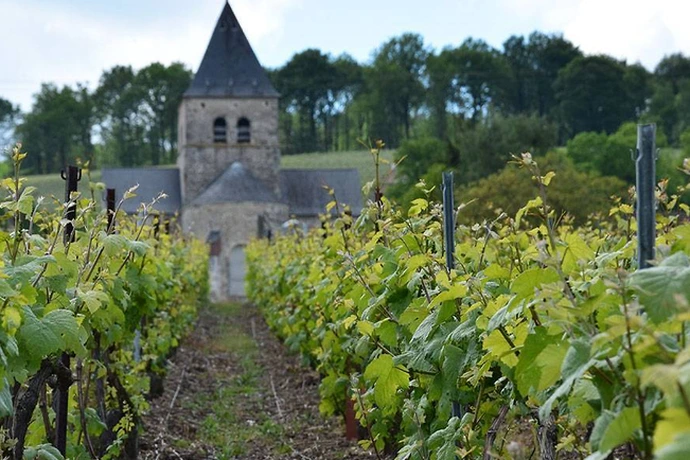
The Lecourt-Barbez Family
The family has always been established in the village of Fleury-la-Rivière and has been involved in winegrowing for as long as vines have been cultivated in Champagne. During the 19th century, viticulture became increasingly important. However, working the densely planted vineyards remained long and exhausting, while bad weather and disease regularly threatened the harvest.
By the end of the 19th century, technological innovations began to make life easier for winegrowers. Champagne prospered – and so did our family.
The Payer Family
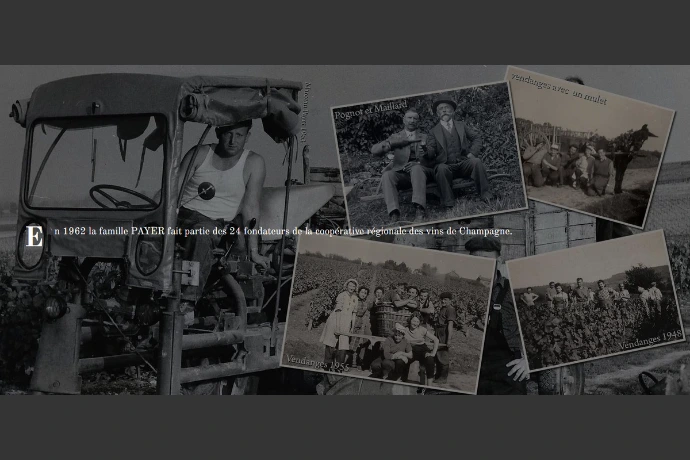
The Payer family originally came from a family of millers. One of the sons married a winegrower's daughter from Romery, just two kilometres from Fleury-la-Rivière. This union gave birth to **Champagne Payer in 1854**. However, difficult times lay ahead for Champagne. In 1890, phylloxera devastated the vineyards, and riots broke out in 1911. Faced with these hardships, a strong spirit of solidarity and mutual support developed among the winegrowers.
They joined forces to replant the vineyards and produce their own wines, sharing equipment such as presses and tanks. This marked the beginning of winegrowers' cooperatives.
The House
**“We own four hectares of vineyards. It is a small estate, but one that allows us to control every stage, from the vineyard through to the wine, and to produce high-quality Champagne.”**
Vineyard work, harvesting, blending, bottling and manual disgorgement – all these stages are carried out on the estate to produce Brut Tradition, Brut Rosé, Demi-Sec Tradition, Brut Magnum and Ratafia Rubis.
**“At the same time, we have maintained our cooperative spirit. This is why part of our harvest is still entrusted to the cooperative, where two of our cuvées are produced: Brut Réserve and Millésime.”**
Good Things Take Time
At Champagne Payer, the wines remain in the cellar for as long as necessary to allow their aromas to develop fully – considerably longer than the minimum 15 months required by Champagne regulations. Our non-vintage cuvées therefore age for at least **3 to 10 years** before being released.
**“Unlike other wines, Champagne improves in the winegrower's cellar rather than in the customer's cellar. Ageing on the lees gives Champagne its unique balance between aromatic intensity and freshness.”**
The Terroir
The estate owns four hectares of vineyards divided among around twenty parcels in Fleury-la-Rivière, planted with **45% Meunier, 45% Chardonnay and 10% Pinot Noir**.
We work with respect for nature, with the aim of passing our land on to future generations as we ourselves received it. We practise responsible viticulture and devote particular attention to the soil that nourishes our vines.
Vine Pruning
Pruning is one of the foundations of
viticulture. Regulated in Champagne since 1938, only four pruning methods are
authorised. We use **Chablis** and **Cordon de Royat** pruning.
These techniques deliberately limit yields in order to improve grape quality and achieve a greater concentration of aromas.
Disbudding and Trellising
Careful disbudding and trellising help minimise
the development of disease and rot, thereby reducing the need for plant
protection products.
The Harvest
The grapes are harvested entirely **by hand**
to ensure that they remain intact.